
Digital signage & emergency alerting
Every screen in the building. One panel. Seconds to reach them all.
Self-hosted digital signage with an emergency channel that actually interrupts. Run playlists on the televisions you already own, and take every one of them the moment something matters.
People
Welcome, Sarah
Joining today as Operations Lead
Canteen
Today’s menu
Servery open until 15:00
Company
Q3 results are in
Revenue up 18% on the quarter
People
Welcome, Sarah
Joining today as Operations Lead
Fire drill at 15:00
Please make your way to the rear car park.
Reception Main · Android TV
- Self-hosted
- Your server. Nothing leaves the building.
- No per-screen fee
- The fiftieth costs what the fifth did.
- Covers other apps
- A news channel is interrupted, not queued behind.
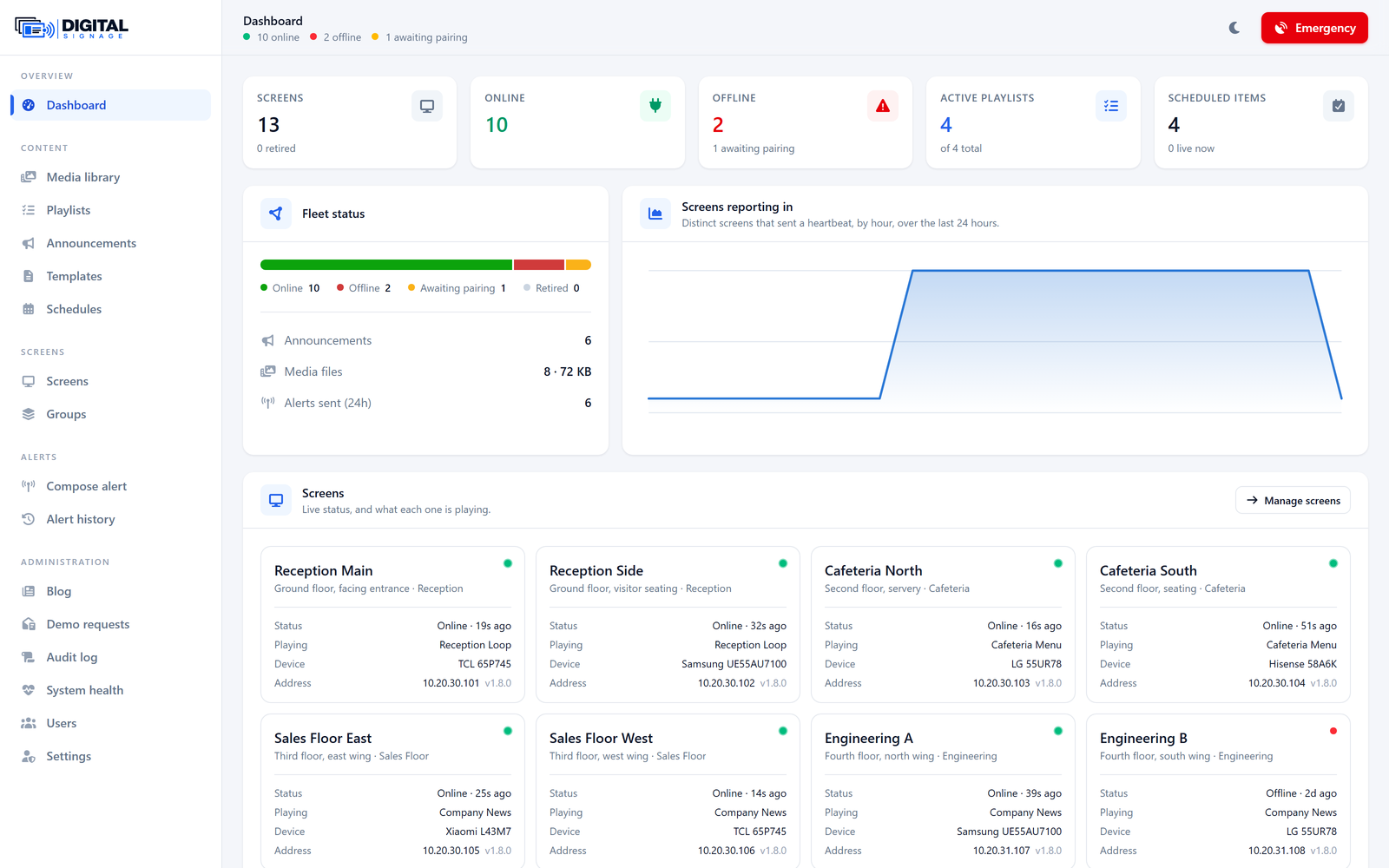
The panel
One place for every screen you own.
- 2–5s
- From send to on screen
- Measured on shared hosting with no WebSocket
- 25+
- Screens on one modest server
- Far more with a database upgrade
- 0
- Per-screen licence fees
- Self-hosted, on your own hardware
- 100%
- Playback while offline
- Content runs from local storage
The problem
A hundred screens, and no way to reach them at once
Most buildings already have the screens. They are showing a news channel, a slideshow somebody set up two years ago, or nothing at all. Changing what is on them means walking to each one with a USB stick.
And when something actually matters — a fire drill, an evacuation, a visitor at the gate — there is no way to put it on all of them. By the time the message has gone round, the moment has passed.
What this does instead
- One panel, every screen in the estate, from a laptop
- An emergency alert takes all of them in two to five seconds
- It interrupts whatever is playing, including another app
- Screens keep working when the network does not
- Runs on the televisions you already own
- Your server — nothing leaves the building
What it does
Everything the estate needs, in one panel
Six capabilities that between them cover the whole job — from the loop on a lobby wall to the alert that takes the building.
Know which screens are lying to you
A wall that has quietly stopped working looks exactly like a wall that is working — right up until somebody walks past it.
- Online, offline and awaiting-pairing counts, live
- What each screen is playing right now — reported by the screen, not assumed
- Screens that cannot cover another app are flagged
- A day of uptime history per screen, so an intermittent set is provable
On the wall
What everybody else sees
Every screenshot above is the panel, which is what an operator sees and not what anyone else does. These are the product from the corridor.
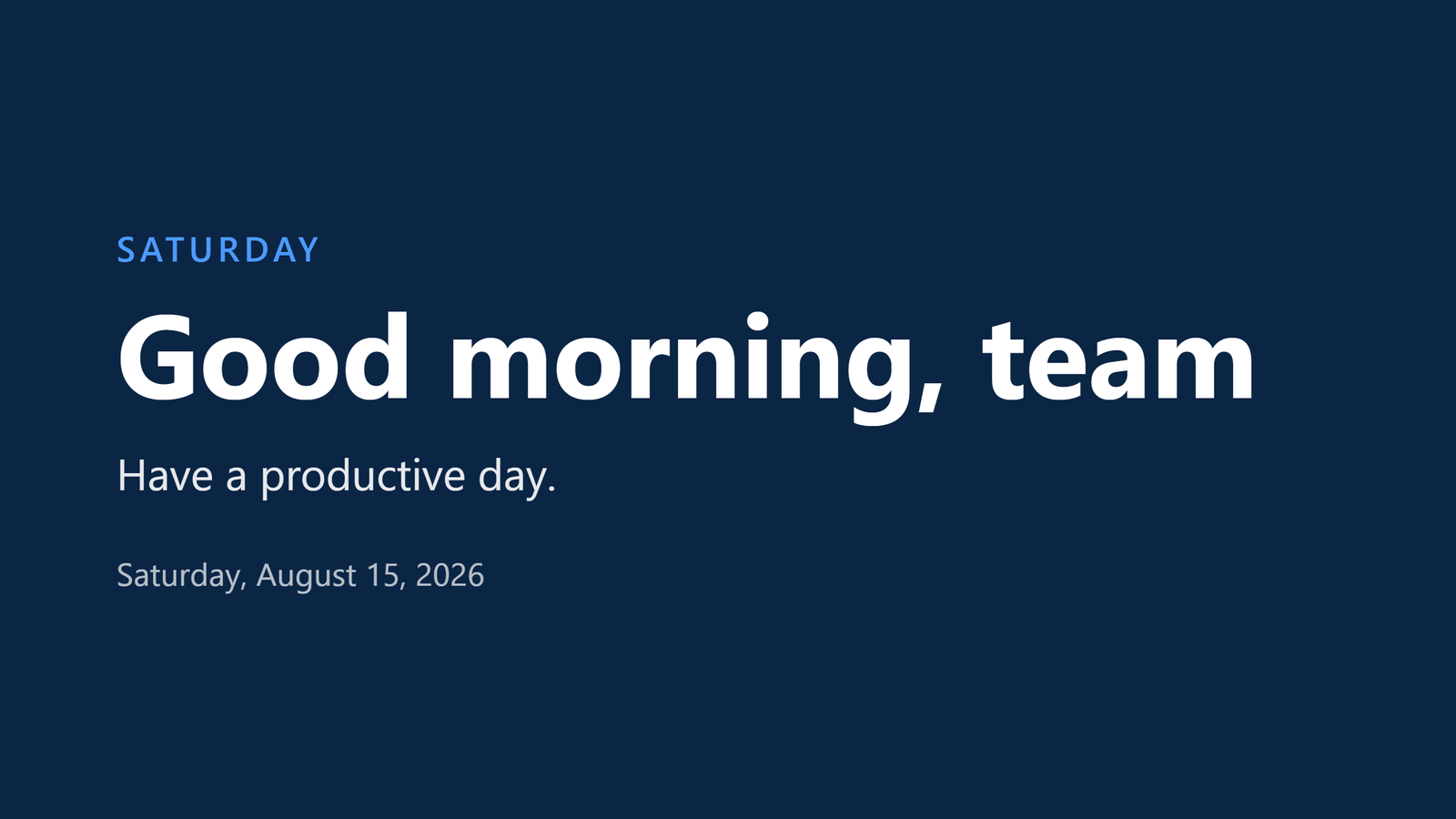
Content playing
A designed announcement from the loop, filling the screen.
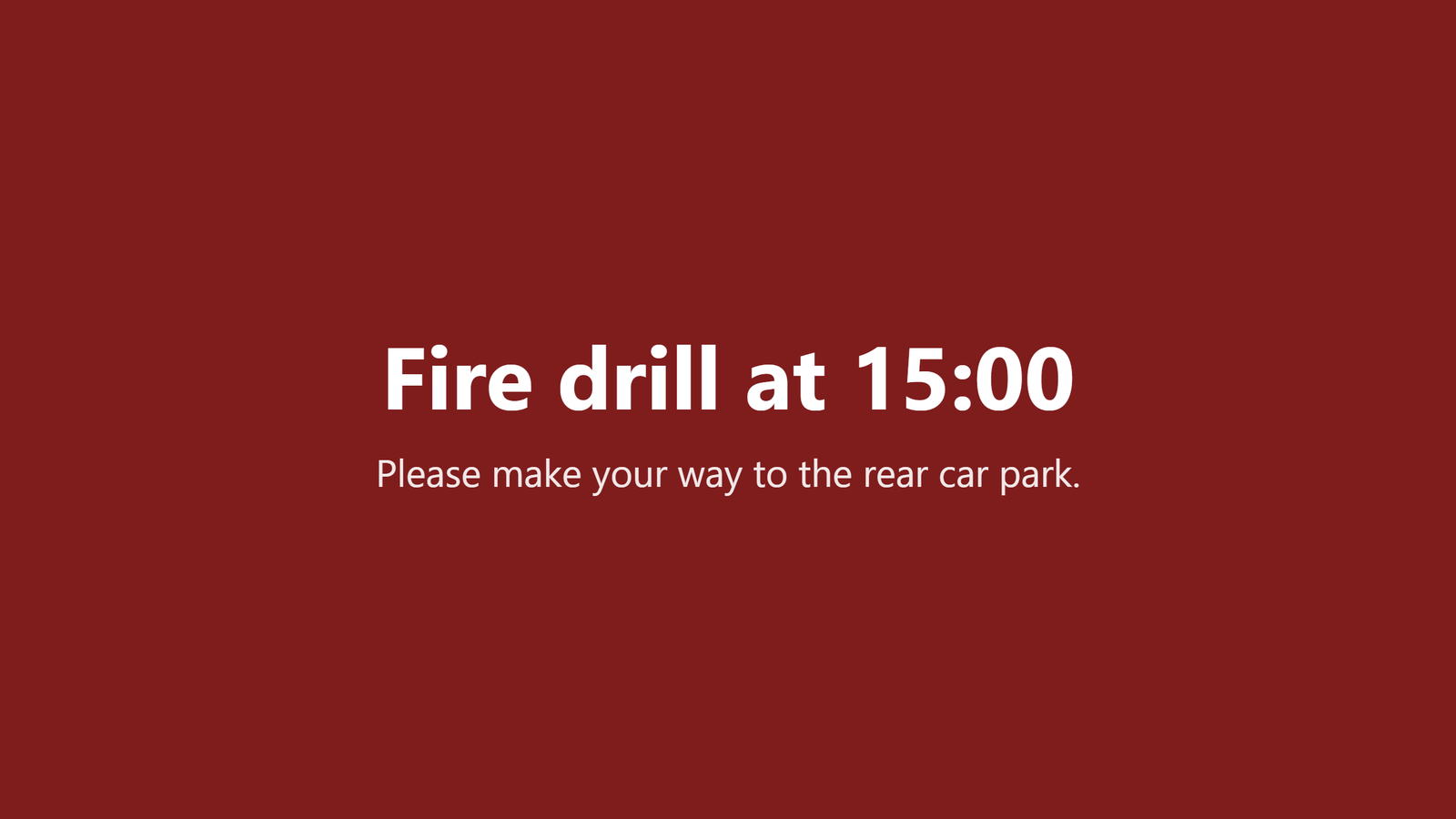
An emergency alert
Takes the whole screen, whatever was playing, until its time is up.
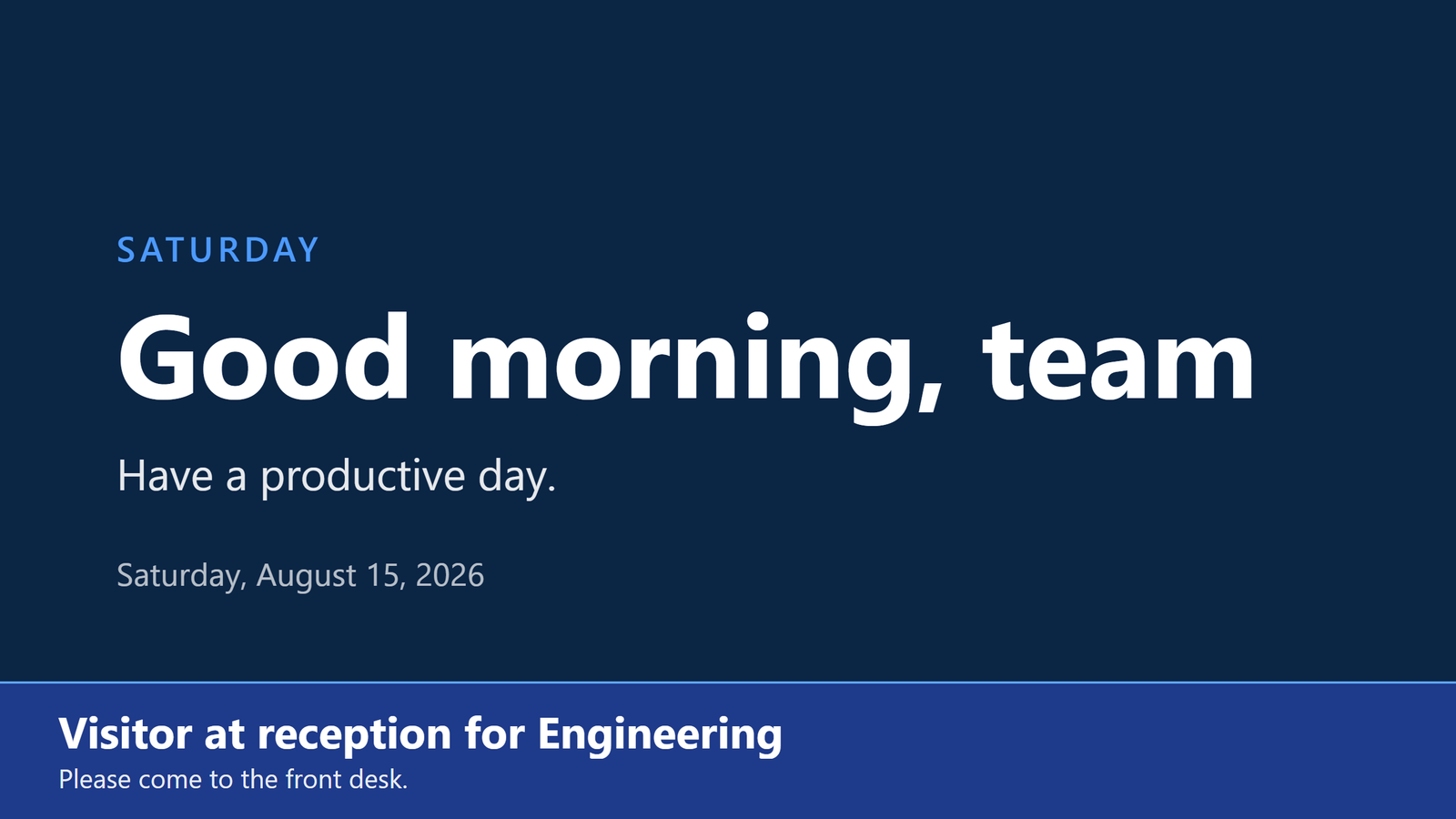
A banner over content
Lower priority interrupts less: the loop keeps running underneath.
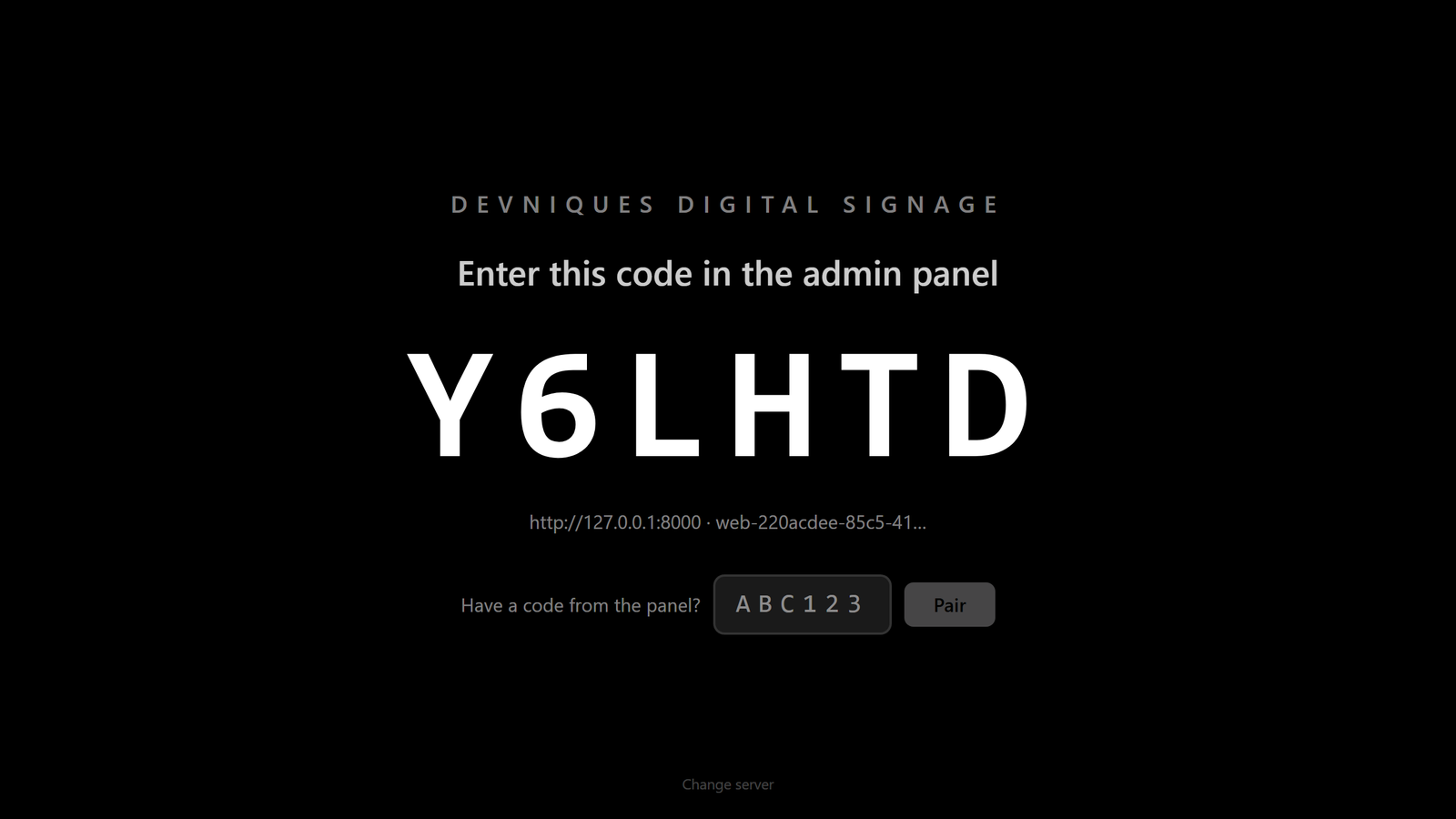
A screen waiting to be paired
Six characters, typed into the panel once. That is the whole setup.
Where it runs
Four ways onto a screen
Nothing here needs new hardware. Pick whichever suits each room, and mix them freely across one estate.
Android TV & boxes
The full experience
A single APK on any Android television, Fire TV stick, or set-top box. Everything the product can do, it can do here.
Samsung & LG
Nothing to install
Open a URL, make it the homepage. No app store, no side-loading, no box.
Web player & PWA
Any browser, any box
Mini PCs, Chromeboxes, a Raspberry Pi behind a screen, or a laptop you are evaluating on.
Phones & tablets
Alerts reach people, not only walls
The same Android app on a phone. It brings itself to the front when an announcement arrives, even from closed.
A television that is not smart at all takes an inexpensive Android box on its HDMI port and behaves like the first card.
Getting started
Two minutes per screen
No account to create, no licence key to type, nothing to configure on the device beyond your own server address.
- 1
Install a player
One APK on an Android television, or a URL in any browser. Nothing to configure on the device itself.
- 2
Pair it from the panel
The screen shows a six-character code. Type it into the panel, name the screen, and it starts playing.
- 3
Build a playlist
Upload images and video, or use one of eight announcement layouts. Set what each item shows for.
- 4
Schedule it, then forget it
Assign to a screen, a group or everything. The right content appears at the right hour on its own.
- 5
Interrupt when it matters
Compose an alert, choose its priority, send. Every screen carries it within seconds.
Who it is for
Anywhere people walk past a screen
The same system, pointed at a different problem.
Offices
Reception loops, meeting-room boards and company news — plus a fire-drill alert that reaches all of them at once.
Read moreFactories & warehouses
Shift boards, line status and safety messaging on screens that keep working when the network does not.
Read moreHealthcare
Waiting-room information and department wayfinding, with an alerting layer that takes precedence when it has to.
Read moreRetail & hospitality
Menus, offers and opening hours, on a schedule, across every site you run.
Read moreEducation
Notices, timetables and events across faculties — and a lockdown channel that reaches all of them.
Read morePublic sector
For organisations where where the data lives is the first question, not the last.
Read moreNothing leaves your building
Entirely self-hosted. No external service is contacted at runtime, and there is no vendor cloud holding your content.
Security & privacyBuilt to still work in ten years
Boring, long-lived technology on purpose: PHP, a relational database, a native Android app. Nothing here depends on a startup staying in business.
The technologyPriced once, not per screen
Adding the fiftieth screen costs exactly what adding the fifth did — nothing.
PricingSee it running on your own screens
We will set up a live system with your own login, and walk you through anything you want to see.
No open demo, no sign-up wall — a person reads every request.